
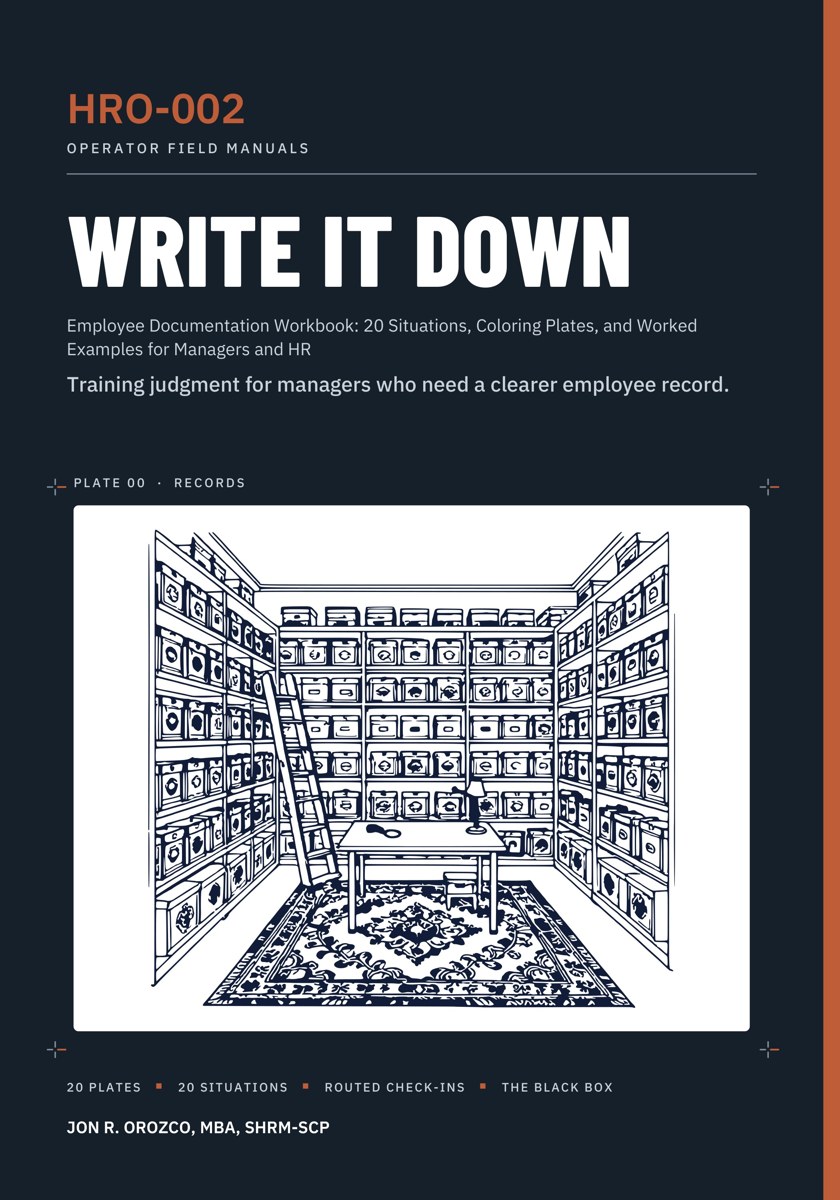
Employee documentation
Write It Down
Employee Documentation Workbook: 20 Situations, Coloring Plates, and Worked Examples for Managers and HR
Write a factual record someone else can understand, with the employee’s account and a clear next step.
Coming to Amazon
The paperback is being prepared for release. A purchase link will appear here when the Amazon listing is available.
Try a sample situationWho this is for
Managers and HR professionals practicing factual employee documentation.
Employee records omit facts, support, or follow-up and rely on labels or memory.
The current manuscript includes 20 practice situations, reflective coloring plates, worked debriefs, and 16 practical tools.
The practice inside
01Make the Record Useful
Practice facts a reader can check, honest dates, and a record of support as well as problems.
02The Four Moves
Capture it. Specify it. Record your response. Schedule the next step. Every good record runs the same four moves, whatever the situation.
03Words That Hold Up
A record is the conversation that outlives the room. This part is about the words you choose when you are tired, annoyed, or short on time.
04Decide, Route, and Keep It Up
Not everything needs a formal file, and some things go straight to HR or counsel. This part sorts the pile and builds the habit.
A situation from the manuscript
Show us what happened
A former employee questions a decision eleven months later. Counsel asks what happened. You believe the decision was sound, but most conversations were verbal. Which kind of record would have helped the review?
What is your strongest answer?
- Everyone knew. Ask anyone on the team.
- A dated, factual note written that week, with the follow-up.
- The manager handled it verbally, and handled it well.
Make your call, then read the field note
A timely, specific record helps a reviewer understand the sequence. It supports the review; it does not settle whether the decision was justified.
Verbal accounts can contribute, but "everyone knew" gives no specific source, date, or next step.
A note written near the event, checked for accuracy, gives the reviewer a starting point and a sequence.
Handling something verbally may be appropriate, but it leaves the later review dependent on memory.
Try this next: Document one current decision. For older events, use today's date, label the entry late, and distinguish memory from verified facts.
Practice with fictional details. This excerpt offers general education, not legal, financial, or clinical advice. Use approved workplace processes and qualified support for real cases.
Tools you can return to
- Your 30-day capture plan
- Twelve checks for every record
- Quick incident log
- Quick incident note
- What do I write down?
- Build a coaching record
- My documentation debt ledger
- Paper trail bingo
- The record-keeping discipline
- Twelve weeks of habits
- Words I rewrote
- The three-tier habit
- Stop and call HR or counsel
- Weekly records review
- Chronology builder
- Your records check-up
Put the practice to work
Use one situation for individual reflection or a manager discussion. Compare your first response with the field note, then choose one change to try in the following week.
Read: Employee documentation: write the fact before the label →Discuss a team learning session →A book supports practice. For an active workplace issue, follow your organization’s process and seek appropriate professional guidance.
Keep exploring
Solo HR
Triage competing cases, make the queue visible, and give each next action an owner and a date.
Promoted Over Your Peers
Practice the shift from coworker to supervisor without turning friendship into favoritism.
The Decision Field Manual
Name the owner, size the stakes, and record the reasons so the same decision stops coming back.