
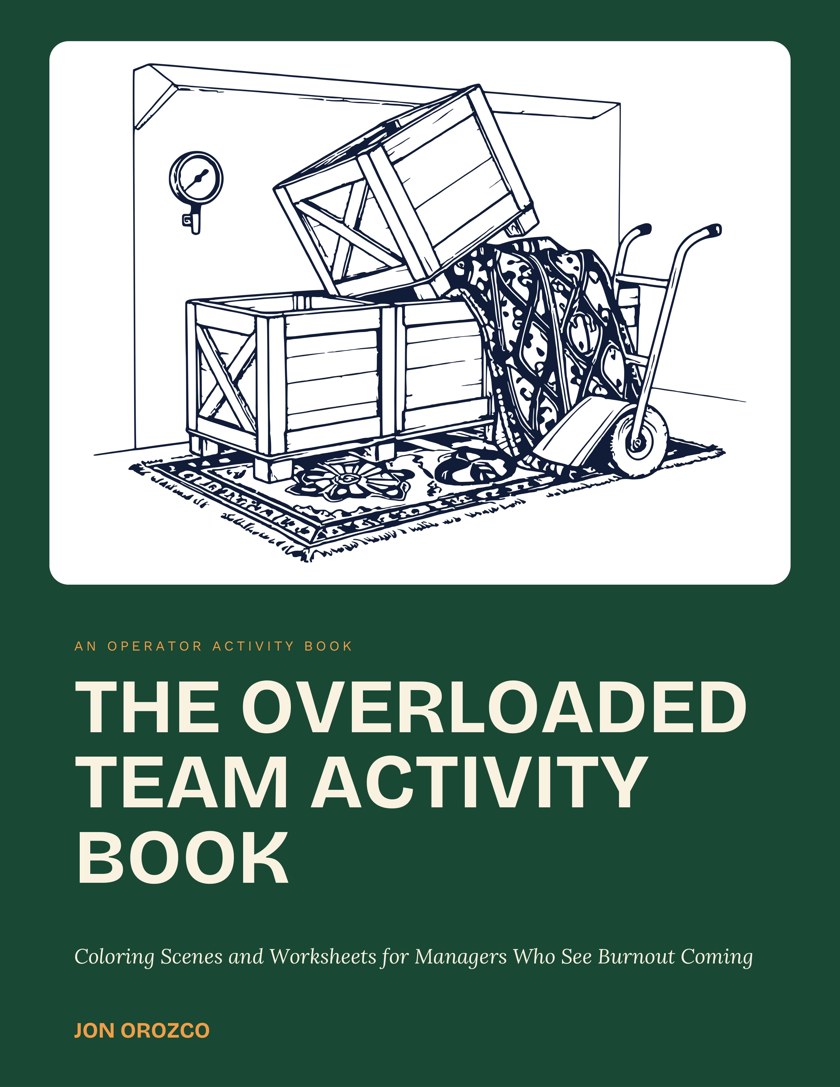
Team capacity
The Overloaded Team Activity Book
Coloring Scenes and Worksheets for Managers Who See Burnout Coming
By Jon Orozco
A way to spot load early, redistribute it, and protect people without losing results.
In development
This title is being developed. The sample below introduces the current manuscript; release details may change.
Try a sample situationWho this is for
Managers whose teams are stretched thin, and the HR partners who support them.
Managers see the signs of overload and do not know what to take off the plate first.
The current manuscript includes 20 practice situations, reflective coloring plates, and 16 practical tools.
The practice inside
01Read the Signals
Overload shows in people before it shows in results. This part trains your eye for the early signs, the ones that appear while everything still ships.
02Measure the Load
A feeling starts the conversation. A number finishes it. This part turns stretched into a percent, a cost, and a case you can show your boss.
03Take Load Off
Once you can see the load, take some off. This part covers stopping work, trading instead of stacking, and building recovery into the calendar.
04Hold the Line
Relief only counts if it lasts. This part covers your own pressure, the record you keep, who needs to know, and how to rebuild trust after a hard stretch.
A situation from the manuscript
Still shipping
Your strongest analyst has hit every deadline for three months. This month her camera stays off, her updates shrank to one sentence, and she has not booked a day off. A peer shrugs and says she looks fine.
What do you check first?
- The delivery dates. She is on time, so she is fine.
- The behavior. Camera, updates, time off, and who she talks to.
- The score on the next engagement survey.
Make your call, then read the field note
Output is the last thing to fail, so it is a late signal. Behavior moves first. Watch what people do, not only what they ship.
Try this next: Pick one strong performer and write down three behaviors you have noticed this month.
Practice with fictional details. This excerpt offers general education, not legal, financial, or clinical advice. Use approved workplace processes and qualified support for real cases.
Tools you can return to
- Your 45-day relief plan
- Capacity audit
- Team load check
- Intervene, redistribute, or watch?
- Saturation tracker
- Load talk builder
- Overload bingo
- Twelve weeks of relief
- Weekly capacity check
- Decision log
- Who needs to know?
- Recovery plan
- Shed-first list
- Twelve checks against collapse
- Pressure translator
- The 30-day relief challenge
Put the practice to work
Use one situation for individual reflection or a manager discussion. Compare your first response with the field note, then choose one change to try in the following week.
Discuss a team learning session →A book supports practice. For an active workplace issue, follow your organization’s process and seek appropriate professional guidance.
Keep exploring
Write It Down
Write a factual record someone else can understand, with the employee’s account and a clear next step.
Solo HR
Triage competing cases, make the queue visible, and give each next action an owner and a date.
Promoted Over Your Peers
Practice the shift from coworker to supervisor without turning friendship into favoritism.