
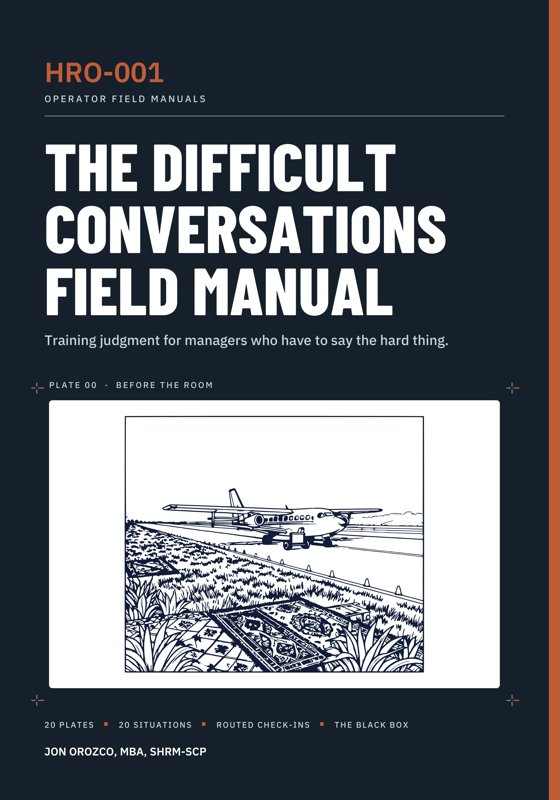
Difficult conversations
The Difficult Conversations Field Manual
20 Hard Talks at Work, Coloring Plates, and Scripts for Managers and HR Who Have to Say It
By Jon Orozco
Prepare the hard talk, practice clearer language, and know when to pause and route the issue.
Coming to Amazon
The paperback is being prepared for release. A purchase link will appear here when the Amazon listing is available.
Try a sample situationWho this is for
HR professionals, managers, and team leads who have to hold a hard conversation this month.
Managers and HR avoid hard conversations until they get worse and have no safe way to practice.
The current manuscript includes 20 practice situations, reflective coloring plates, worked debriefs, and 16 practical tools.
The practice inside
01Before the Room
The hardest part of a hard talk is the week before it. This section takes you from dreading it to scheduling it.
02Frame, Observe, Listen, Commit
The Four-Phase Conversation Arc keeps a hard talk short, specific, and fair. Run the phases in order, and do not skip one.
03Hold the Room
The script is the easy part. This section covers the words that wreck a talk, the moment the room shifts, and staying calm when you feel the opposite.
04Stop, Record, Repair
Some talks are not yours to run alone. This section covers when to stop and bring in HR or counsel, how to write a clear record, and how to rebuild trust afterward.
A situation from the manuscript
The right moment
You spotted the problem nine days ago. Every day since, you have found a reason to wait: a deadline Tuesday, a launch Thursday, a better mood next week. You call it waiting for the right moment.
What do you do?
- Wait one more week. Things might fix themselves.
- Put a 45-minute talk on the calendar for this week.
- Drop hints in the team meeting and hope they get it.
Make your call, then read the field note
Waiting is not preparing. It is avoidance with a scheduling excuse. The real decision is to have the talk, and everything after that is logistics.
Waiting feels practical, but the cost keeps running. Nine days becomes sixteen, and the team already sees it.
A dated slot turns dread into a task. Forty-five minutes this week is small, and the list of reasons to wait never shrinks.
Hints let you feel you spoke without saying anything. The person who needs to hear it will miss it, and everyone else will hear it.
Try this next: Put the talk on your calendar today, even if the plan is rough.
Practice with fictional details. This excerpt offers general education, not legal, financial, or clinical advice. Use approved workplace processes and qualified support for real cases.
Tools you can return to
- Your 30-day talk plan
- My avoidance inventory
- Twelve checks before the room
- The conversation planner
- Opening line builder
- Never say, say instead
- My pressure pivots
- The calm card
- Which tier is this talk?
- When to stop and route
- Your recovery plan
- Recovery check-in
- Hard-talk running log
- Readiness score
- Twelve weeks of hard-talk habits
- Hard-talk bingo
Put the practice to work
Use one situation for individual reflection or a manager discussion. Compare your first response with the field note, then choose one change to try in the following week.
Read: Prepare the opening before the hard conversation →Discuss a team learning session →A book supports practice. For an active workplace issue, follow your organization’s process and seek appropriate professional guidance.
Keep exploring
Write It Down
Write a factual record someone else can understand, with the employee’s account and a clear next step.
Solo HR
Triage competing cases, make the queue visible, and give each next action an owner and a date.
Promoted Over Your Peers
Practice the shift from coworker to supervisor without turning friendship into favoritism.